

Compare Vacuum Cleaners
Find the right vacuum for your home. Compare specs, filtration, and features side by side.
Compare Vacuums
How to Compare Vacuums
The right vacuum depends on your floors, your household, and how you clean. Carpet-heavy rooms need strong suction and a motorized brushroll. Hard floors do better with a canister or stick vacuum that won't scatter debris. Homes with pets or allergy sufferers should prioritize HEPA filtration over raw power.
Use the filters above to narrow by type, brand, filtration, and price. Pick up to three vacuums and compare their full specs side by side. Every vacuum we sell is backed by our in-store service team, so you get support long after the purchase.
Key Specs That Matter
Suction Power
Measured in amps (corded) or watts (cordless). Higher numbers generally mean stronger cleaning performance on carpets and rugs.
Filtration
HEPA filters capture 99.97% of particles down to 0.3 microns. S-Class filtration is the European equivalent. Both are ideal for allergy and pet households.
Weight
Lightweight uprights start around 8 lbs. Heavy-duty models can exceed 22 lbs. Consider how often you carry the vacuum between floors.
Cord vs Cordless
Corded vacuums deliver constant power for extended cleaning sessions. Cordless models offer freedom of movement but have limited runtime per charge.
Vacuum Types
Upright vacuums are the most common style in the U.S. Motor, brushroll, and dustbin are all in one unit. They excel on carpet and most include onboard tools for above-floor cleaning.
Canister vacuums separate the motor into a wheeled canister connected to the cleaning head by a hose. The cleaning head is lighter to push, quieter, and easier to steer under furniture. Canisters handle mixed floor types well.
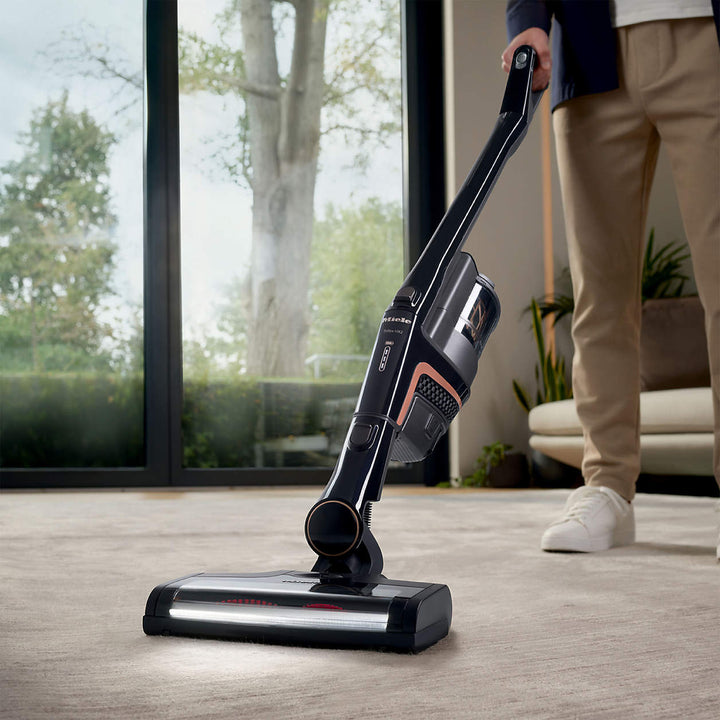
Cordless stick vacuums run on rechargeable batteries and store compactly. Good for quick pickups and smaller spaces, though suction is typically less than a full-size corded model. Runtime ranges from 15 to 60+ minutes depending on the model and power setting.
Handheld vacuums are small, portable units for spot cleaning: crumbs, car interiors, upholstery. Most are cordless.
Central vacuum systems are installed in the walls of a home. You connect a lightweight hose to wall inlets in each room. They run powerful, quiet at the cleaning point, and vent exhaust outside the living space.
Comparing Vacuum Brands
We stock a focused selection of brands chosen for build quality and long-term reliability. Riccar vacuums are assembled in the U.S. and built for deep carpet cleaning with strong suction and HEPA filtration. Sebo is a German manufacturer known for durable motors, low maintenance costs, and hospital-grade filtration. Miele canisters are a go-to for hard floors and mixed surfaces, with sealed filtration and quiet operation. Simplicity delivers solid performance at lower price points with straightforward controls.
Each brand fits different homes and cleaning habits. Use the compare tool above to see how specific models stack up on the specs that matter to you.
View All Vacuum CleanersFrequently Asked Questions
An upright vacuum with a motorized brushroll and strong suction does the best job on pet hair in carpet. Pair that with HEPA filtration to trap dander and allergens before they recirculate. Sealed systems keep fine particles from leaking out of the exhaust. Riccar and Sebo both make pet-specific models with tangle-free brushrolls and easy-to-empty dust compartments.
HEPA filters capture 99.97% of particles 0.3 microns and larger: pollen, dust mite waste, mold spores, pet dander. If anyone in your home has allergies or asthma, HEPA filtration makes a noticeable difference in air quality. S-Class filtration is the European equivalent and meets the same particle-capture standard. Even without allergy concerns, HEPA keeps the air cleaner during and after vacuuming. Most of the brands we carry now include HEPA or S-Class filtration on their mid-range and premium models.
Bagged vacuums hold suction better as they fill, contain dust more effectively at disposal, and keep allergy sufferers from touching the collected debris. Bagless models skip the ongoing cost of replacement bags and let you see when the bin is full. The tradeoff: emptying a bagless bin kicks dust back into the air. For homes with pets or allergy concerns, a bagged vacuum with a sealed HEPA system is the cleaner option. We stock bags and filters for every model we sell.
Most homes do well with a vacuum in the $300 to $600 range. Under $200, you typically get weaker motors and filtration that wears out sooner. Above $600, you get features like sealed HEPA systems, self-adjusting brushrolls, and longer warranties. A $500 vacuum that lasts 10+ years costs less per year than a $150 machine replaced every 2 to 3 years. Our service team can also keep a quality machine running well past its warranty period.
Uprights combine the motor, brushroll, and dustbin into one unit. They cover more floor per pass and work fastest on large carpeted areas. Canisters separate the motor from the cleaning head, so the piece you push across the floor is lighter and easier to steer. Canisters do better on hard floors, stairs, and under low furniture. Many owners with mixed floor types prefer a canister for the flexibility. Your floor layout and how many stairs you have should drive the decision.
They have closed the gap. High-end cordless stick vacuums now match corded suction on their standard power settings. The limits are runtime and sustained power: a corded vacuum never runs out of charge and delivers consistent suction for as long as you need it. Cordless models fit quick daily pickups, smaller homes, and getting into spaces where a cord gets in the way. For deep cleaning thick carpet or whole-house sessions, corded is still the safer bet.
Swap the bag when it is about two-thirds full. Overfilling chokes suction and strains the motor. HEPA filters should be replaced roughly every 12 months. Some washable pre-motor filters can be rinsed and reused, but check your machine's manual for the exact interval. We carry bags and filters for every brand on this page, and our service department can handle deeper maintenance if your vacuum needs it.